Intelligent Document Processing for Insurance: From Submission Packets to Structured Data
Table of Contents
Why Insurance Document Processing Remains a Challenge
According to Regure’s 2026 guide, an auto insurance claim can generate 8 to 15 documents, while complex commercial property claims may involve more than 50. Adjusters can spend 14 hours per week (approximately 40% of their working time) looking for, sorting, and organizing this information.
The problem gets harder when submissions arrive as mixed document packets rather than clean, structured records. A single packet might contain ACORD forms, loss runs, FNOL reports, financial statements, medical records, and supporting attachments, each with different layouts and relevant fields. Manually separating these files and pulling out the information needed for underwriting or claims systems is slow and difficult to scale.
Insurers need a reliable way to identify, separate, and extract information from these documents so it can be used by downstream underwriting and claims systems.
Intelligent Document Processing for Insurance with Unstract
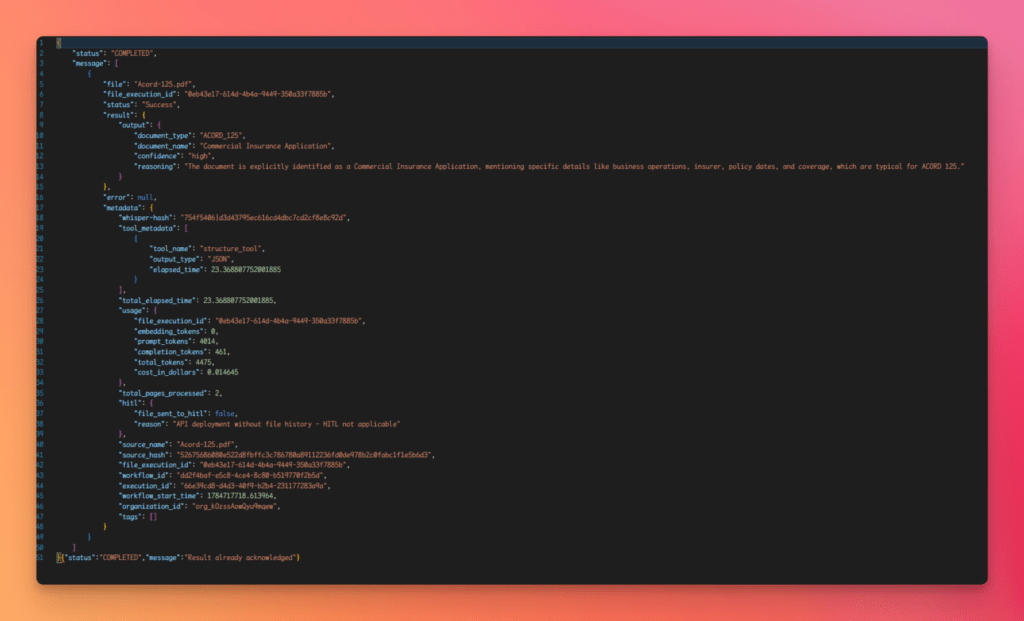
A deployed Unstract workflow can receive an insurance document through an API and return the extracted information as structured JSON. For example, an ACORD form can be submitted with a singleAPI request:
The result is a machine-readable representation of information that was originally embedded in the document. Fields such as policy numbers, coverage limits, insured details, and premiums can now be passed directly to downstream insurance systems for further processing.
Stop manually separating and processing insurance document packets.
A single claim can generate 8 to 50+ documents—ACORD forms, loss runs, FNOL reports, and medical records—each with different layouts. Unstract splits mixed packets, classifies each document, and extracts structured data automatically, without templates or manual sorting.
Try Unstract for free on the Playground. No signup required.
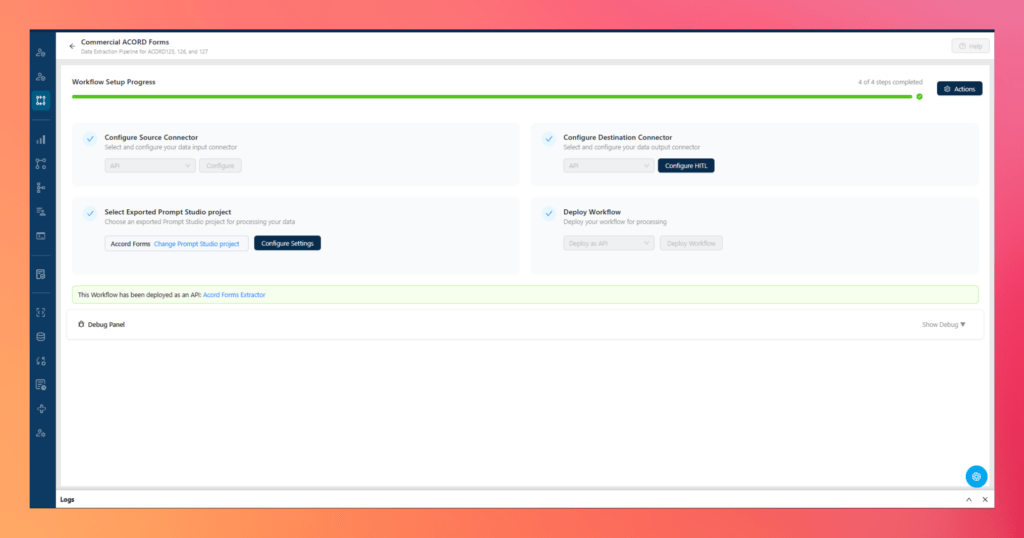
Introducing Unstract: An End-to-End Intelligent Document Processing Platform for Insurance
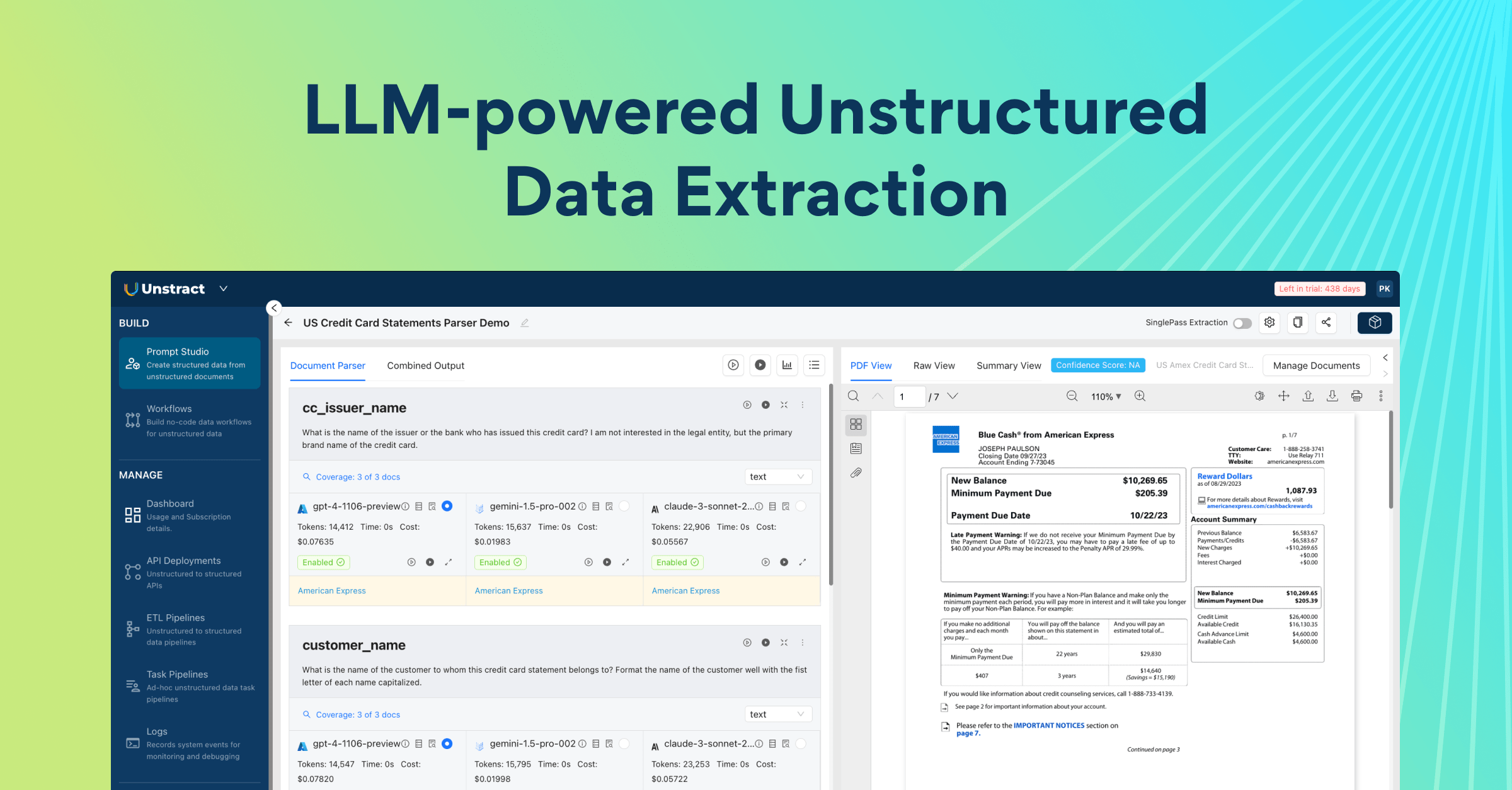
Unstract is an intelligent document processing platform built to extract useful data from documents that do not fit neatly into fixed formats. Rather than relying on templates or rigid rules, it uses LLMs to interpret document content and extract the information required by a workflow.. The platform brings the main stages of document processing into one environment:
Agentic Prompt Studio: Define and test extraction prompts for different document types and use cases.
Workflow Builder: Connect document processing steps into repeatable workflows.
ETL Pipelines: Transform and route extracted data to downstream systems.
API Deployment: Expose workflows through APIs so applications can submit documents and consume structured results.
Unstract can be deployed according to an organization’s requirements, with cloud, on-premise, and open-source options available. This makes it possible to start with document extraction as an isolated workflow and integrate it into larger operational systems as requirements grow.
Why Do Insurance Workflows Operate on Document Packets?
A single insurance claim generates a growing collection of documents throughout its lifecycle. According to the NAIC Market Conduct Record Retention and Production Model Regulation, claim files must include notices of claim, claim forms, proofs of loss, adjuster logs, claim investigation documentation, inspection reports, bills, estimates and valuation worksheets, medical records, correspondence, payment records, and other documentation necessary to support claim handling.
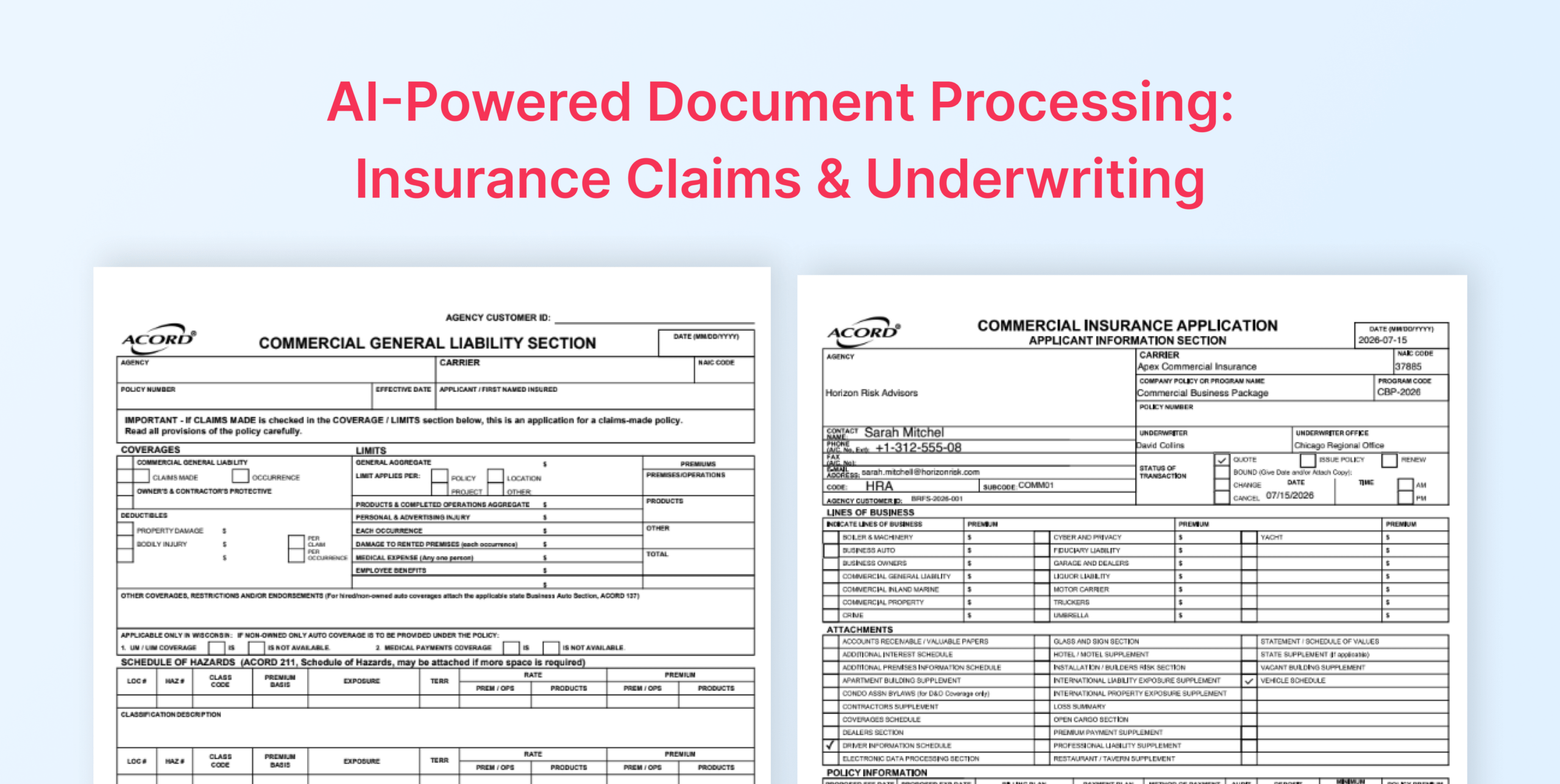
As a result, insurers receive document packets rather than clean, individual files. A commercial submission might contain ACORD 125, ACORD 126, and ACORD 127 forms alongside loss runs, supplemental questionnaires, financial statements, and inspection reports.
Before extracting structured data, the workflow needs to determine where each document begins and ends and what type of document it is.
How Unstract Automates Insurance Document Processing
Unstract provides an end-to-end pipeline for taking insurance document packets from ingestion through structured data output, without requiring teams to assemble and maintain separate services for each stage. This differs from a building-block approach such as AWS, where services like S3, Textract, Comprehend, and A2I provide individual capabilities that teams must connect into a complete document-processing workflow.
Unstract brings these stages together in a single workflow.
For insurance document packets, the workflow can be organized into six stages:
Ingest: Receive a merged submission or claim packet through an upload or API.
Split: Separate a merged submission or claim packet into its individual documents.
Classify: Identify the document type of each file, such as an ACORD form, loss run, inspection report, or financial statement.
Extract: Capture the relevant fields from each document using LLMWhisperer and Agentic Prompt Studio, with extraction logic suited to the document and use case.
Validate: Evaluate extraction confidence, identify missing or uncertain information, and route results that require additional review to a human.
Deploy: Publish the completed workflow as an API or connect its structured output to downstream insurance systems.
The result is a single processing flow that moves a mixed document packet through identification, extraction, validation, and delivery without requiring a separate integration for each processing stage.
How to pick the right document extraction platform in 2026: Legacy IDP to LLMs
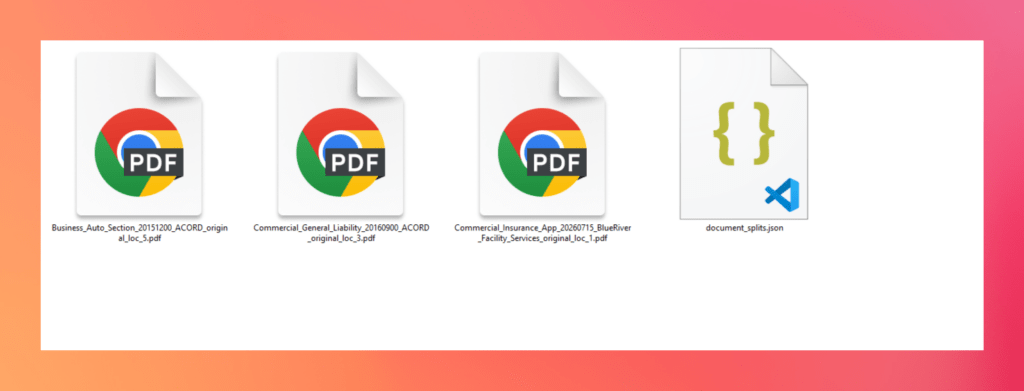
Unstract’s Document Splitter API automatically analyzes a merged PDF, detects document boundaries, and separates the packet into individual PDF documents. The API works without predefined templates or document-specific configuration, making it suitable for different submission formats.
Figure 1: Split documents from the insurance submission packet
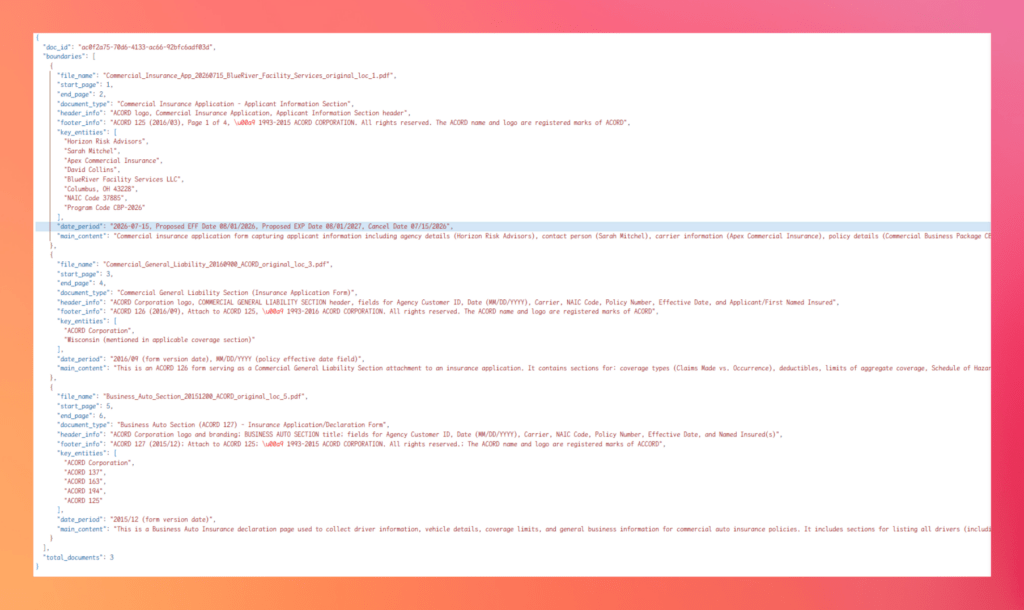
Extracted JSON Results:
Figure 2: Extracted JSON from the split documents
Why Document Splitting Comes Before Extraction
A merged insurance packet cannot reliably be processed with a single extraction schema because each document type contains different fields, layouts, and information requirements.
For example, an ACORD form requires a different extraction structure from a loss run report or inspection record.
Splitting the packet first allows each document to be identified and routed to the appropriate extraction workflow. It also makes it easier to check whether required documents are present before the submission moves into underwriting or claims processing.
Reduce claim processing from 4–6 days to 24–48 hours
Unstract automates document intake, classification, and extraction for ACORD forms, loss runs, and supporting evidence. With intelligent document processing, you can accelerate underwriting, reduce manual effort, and get straight-through processing rates of 60–80%.
Try Unstract for free on the Playground. No signup required.
Once the packet has been split, each document must be identified before extraction begins. Different insurance forms contain different fields, layouts, and business information, so applying the same extraction logic to every document would produce unreliable results.
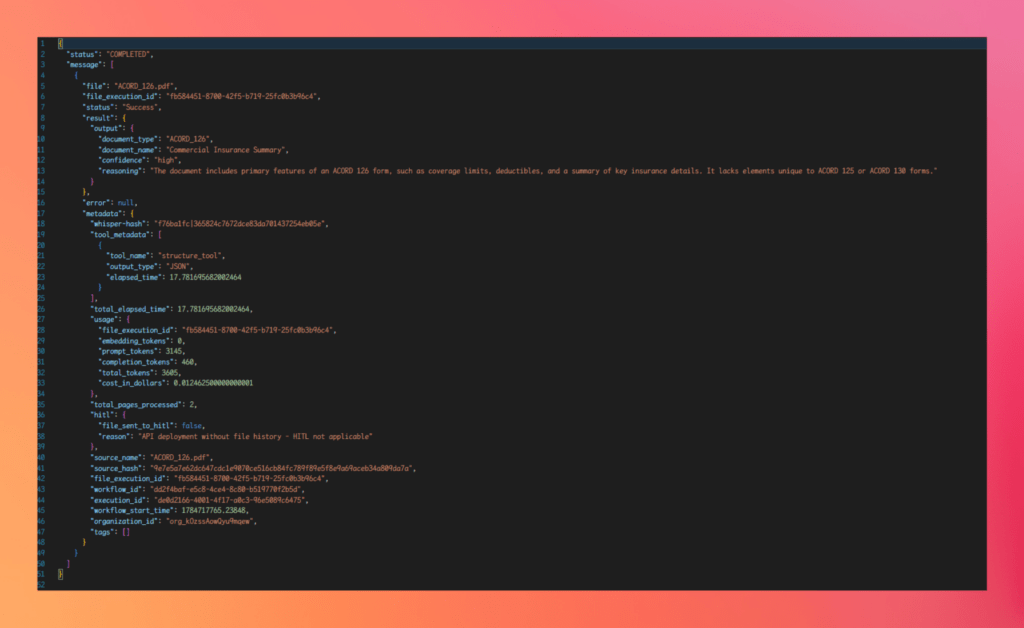
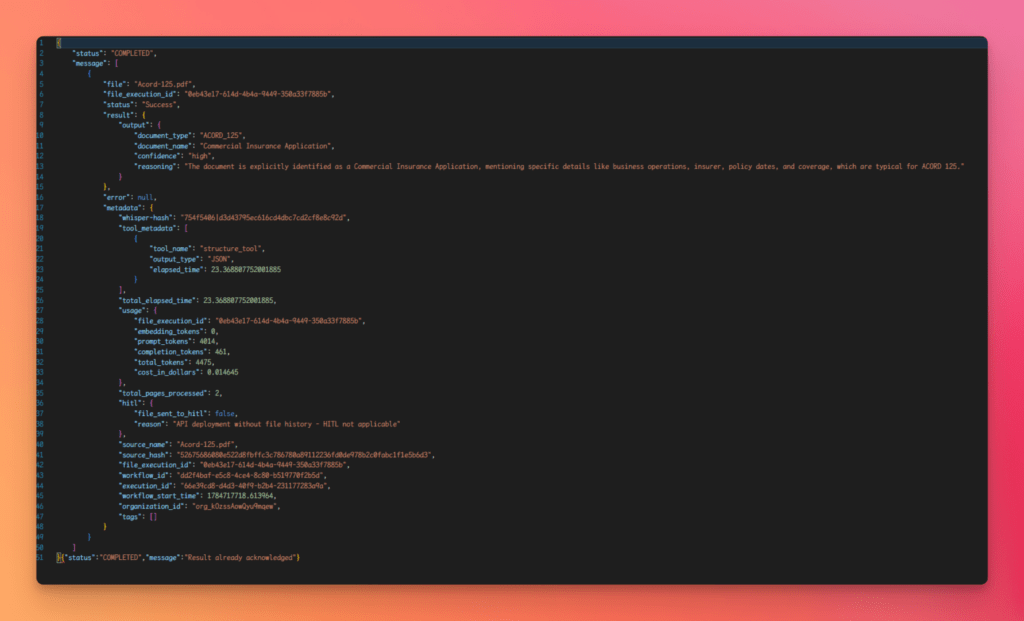
Unstract automatically classifies each document using AI, identifying document types such as ACORD 125, ACORD 126, ACORD 127, loss runs, or supplemental forms.
Results from the three classified documents:
Figure 3: ACORD 125 classification API response
Figure 4: ACORD 126 classification API response
Figure 5: ACORD 127 classification API response
Now that we’ve split our packet and identified each document, let’s extract structured data from the related ACORD forms using Agentic Prompt Studio.
From ACORD forms to Guidewire — automated, auditable, and API-first.
Unstract splits, classifies, and extracts insurance documents, then pushes structured JSON directly to Guidewire, Duck Creek, or your core insurance systems. Source document highlighting, confidence scoring, and Human-in-the-Loop review keep your workflows compliant and audit-ready.
Try Unstract for free on the Playground. No signup required.
After documents have been split and classified, the next step is extracting the relevant insurance information and converting it into structured data.
Unstract Agentic Prompt Studio processes the classified ACORD forms together to understand information across multiple documents. It automatically generates an extraction schema and identifies shared entities such as insured details, producer information, and policy dates.
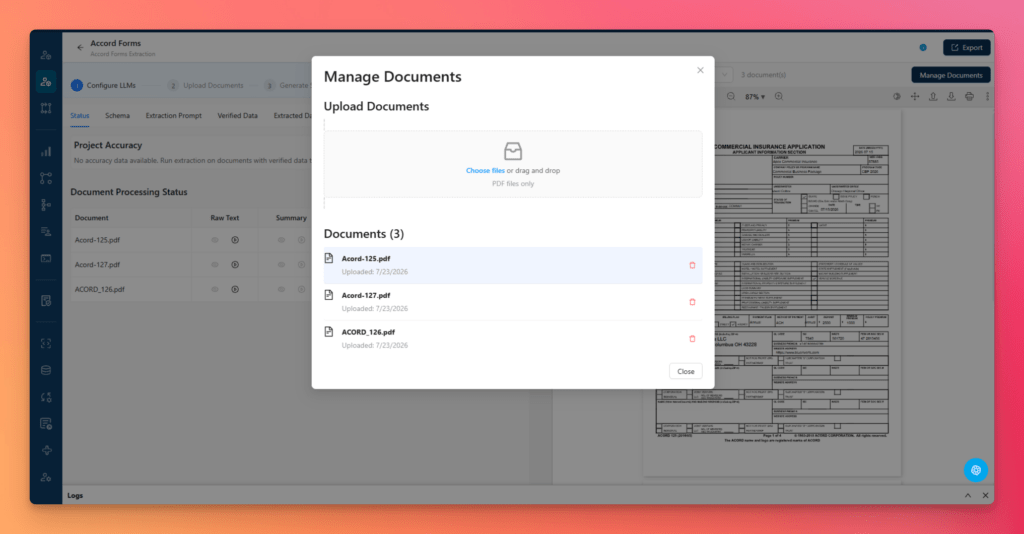
Step 1: Upload Documents
The ACORD 125, ACORD 126, and ACORD 127 forms have been uploaded to the project for extraction.
Figure 6: ACORD forms uploaded to Agentic Prompt Studio
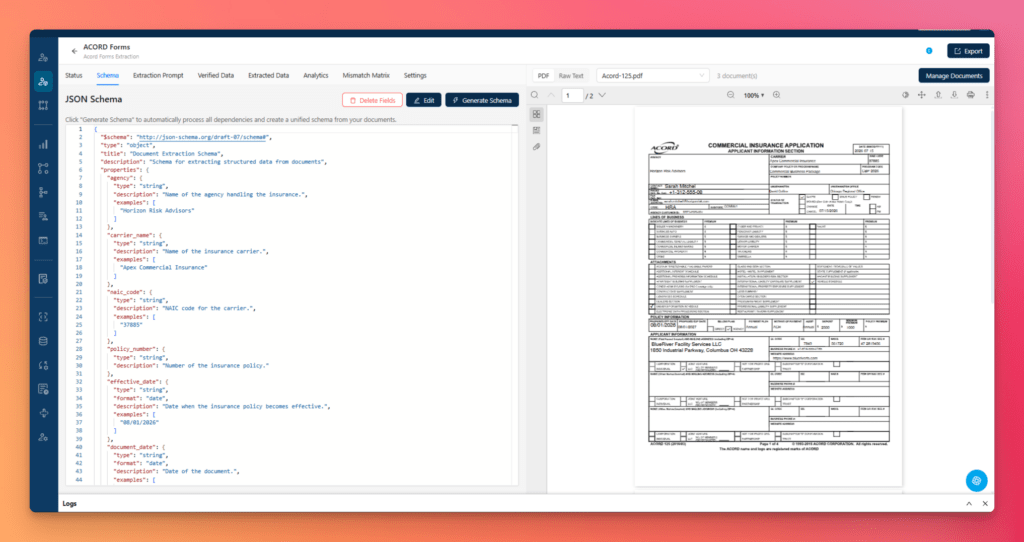
Step 2: Generate Schema
Agentic Prompt Studio automatically builds a unified extraction schema that normalizes shared entities across document variants.
Figure 7: Extraction schema generated from the ACORD forms
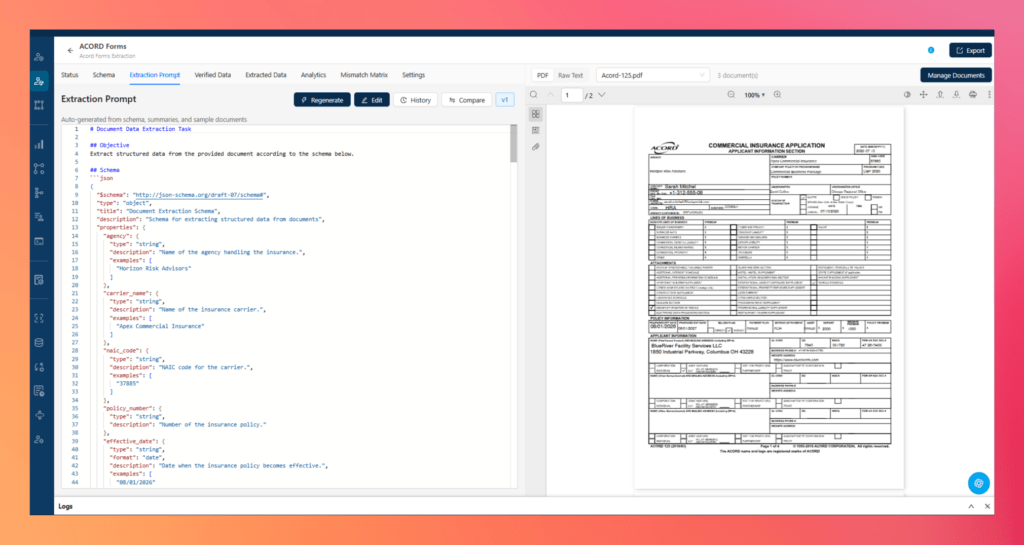
Step 3: Generate Prompts
The platform generates production-ready extraction prompts without manual prompt engineering.
Figure 8: Generated extraction prompts
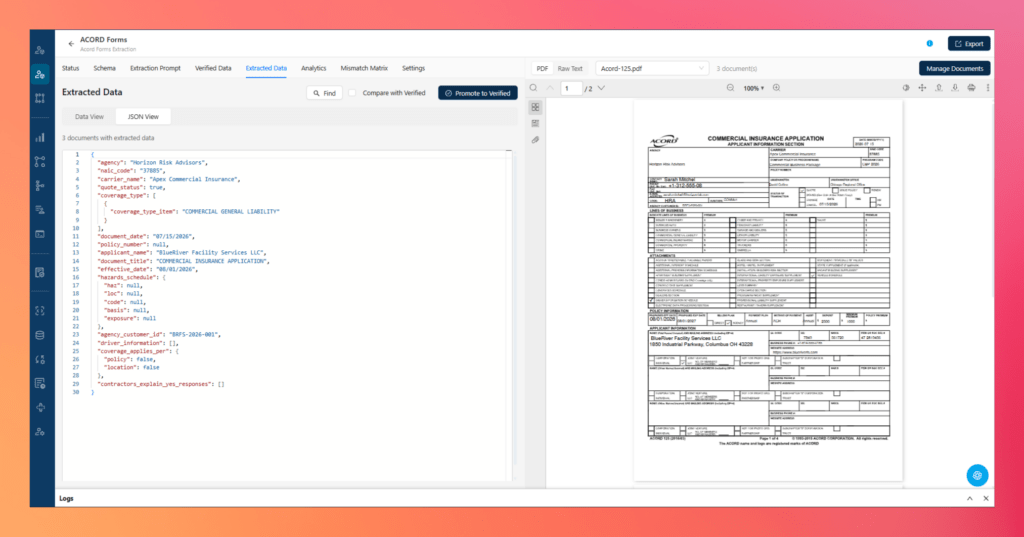
Step 4: Run Extraction & Review Accuracy
Extracts structured data with field-level accuracy scoring and mismatch review.
Figure 9: Run Extraction & Review Accuracy
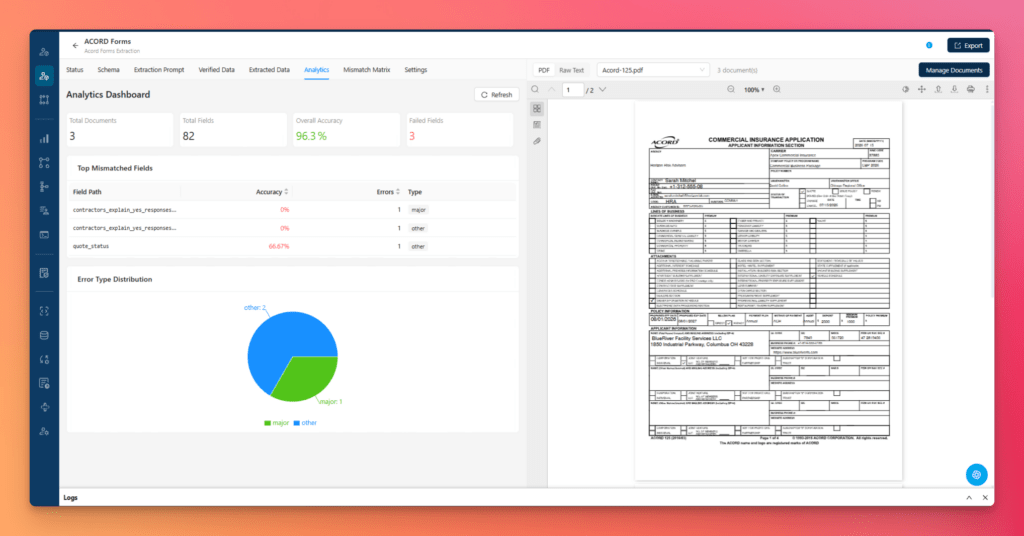
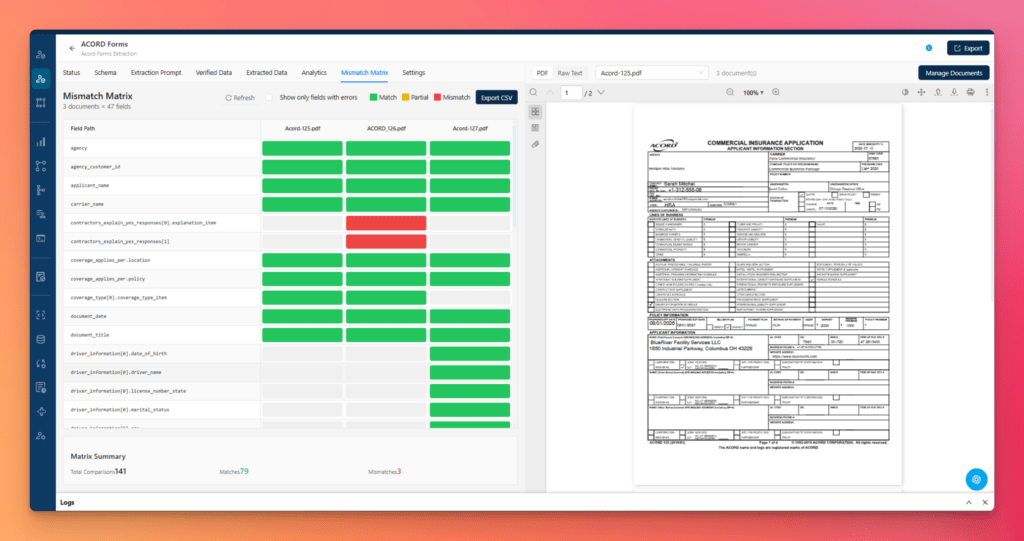
Step 5: Analytics & Mismatch Matrix
Visualizes extraction performance, error distribution, and field-level mismatches.
Figure 11: Extracted data mismatch matrix
Step 6: Export as API Endpoint
Deploys the extraction workflow as a production-ready REST API.
Figure 12: Deploying workflow as an API
Step 4: Pushing Data Downstream with Guidewire PolicyCenter Integration
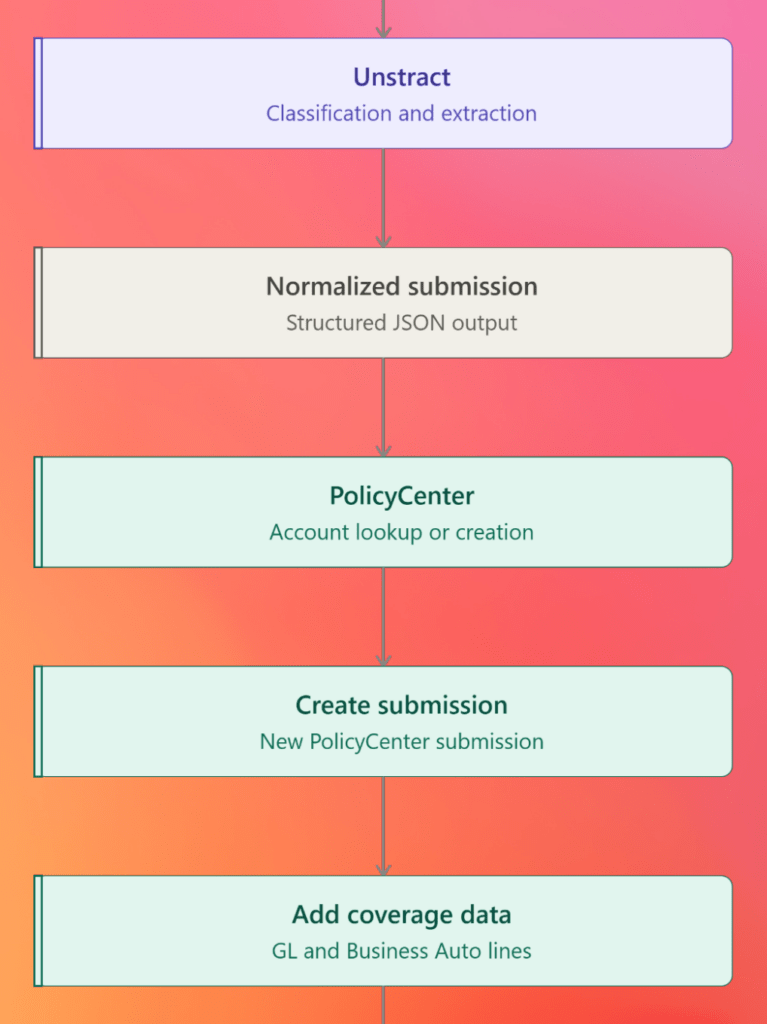
Guidewire Software PolicyCenter manages policy administration and underwriting for new business and renewal submissions, making it a suitable target for data extracted from commercial insurance forms such as ACORD 125, 126, and 127.
Once Unstract has classified and extracted the forms, the results can be consolidated into a normalized JSON payload and passed to PolicyCenter through its REST APIs. Guidewire API paths and implementation details vary by version and deployment, so the pattern below represents a typical integration for this process.
Figure 13: End-to-end insurance document extraction and underwriting flow
Typical API operations include creating or locating the applicant account and creating the corresponding submission. The extracted JSON provides the data needed to populate these downstream workflows.
The integration boundary is the JSON format. Unstract handles document processing and extraction, while PolicyCenter receives the structured data from submissions.
Recommended Extraction-to-Core-System Workflow
Once insurance documents have been split, classified, and transformed into structured data, the next step is integrating that information into core insurance systems.
Unstract prepares validated, structured data that can flow into policy administration, claims management, or underwriting workflows while preserving the original source documents for review and compliance.
The table below breaks down each workflow step, from initial extraction through compliance and audit, along with the downstream action and business outcome it supports.
Workflow step
Description
Downstream action
Business outcome
Extract
Extract policy, claim, insured, coverage, producer, and date information
Valid results continue automatically and exceptions are flagged
Fewer data errors and incomplete submissions
Human review
Route low-confidence or high-value results for review
Reviewer verifies the extracted data against the source document
Human oversight where judgment is needed
Create draft record
Send validated data to systems such as Guidewire or Duck Creek
Create a draft policy, quote, or claim record
Faster system entry without bypassing controls
Attach source document
Retain the original ACORD form or claim document
Link the source to the downstream record
Easier verification and traceability
Approval and binding
Move the submission or claim through existing approval processes
Approve, bind, or initiate claim handling
Automation supports the workflow without replacing required decisions
Compliance and audit
Structured data remains associated with the original source documents and review history
Maintain records for audits and subsequent reviews
A complete, reviewable audit trail
This workflow connects document extraction to the systems insurers already use, while keeping validation, human review, and existing approval processes in the loop.
Teams That Benefit from This Workflow
The table below breaks down the workflow benefits for each team and the resulting business impact.
Team
Workflow benefit
Business impact
Claims Operations
Faster document intake, extraction, and claim setup
Less manual processing and faster claim handling
Underwriting
Structured submission data with source-document verification
Faster submission review and more consistent data
Broker/MGA Operations
Automated handling of incoming submission packets
Higher processing capacity with less manual effort
Compliance & Audit
Structured records linked to source documents
Better traceability and audit readiness
IT & Engineering
API-based integration with core insurance systems
Less custom document-processing infrastructure to maintain
Together, these steps turn extracted document data into a controlled, traceable workflow that can feed core insurance systems without removing validation or human oversight.
Auditability for Regulators
Insurance organizations operate under strict regulatory requirements that demand transparency and traceability throughout document processing. Intelligent document processing workflows require transparency, governance, and review capabilities alongside extraction accuracy.
Unstract supports auditability through several capabilities:
Human-in-the-Loop (HITL): Route low-confidence extractions to human reviewers for verification before data enters downstream underwriting or claims systems, improving accuracy for business-critical workflows.
Source Document Highlighting: Link extracted fields directly to their locations in the original document, enabling reviewers to quickly validate values during audits, compliance checks, and quality reviews.
Model, Prompt, and Schema Version Tracking: Record the prompts, schemas, and extraction configurations used for each document, making it easier to review changes and maintain consistent processing over time.
Confidence Scoring: Assign confidence scores to extracted fields so high-confidence results can be processed automatically while lower-confidence results are routed for human review.
Watch: How to turn complex insurance document tables into usable data with AI
Where Traditional Processing Breaks Down in Insurance
Insurance documents are highly variable. Submissions and claims contain ACORD forms, supplemental forms, loss runs, endorsements, and supporting documents from different carriers, making traditional template-based processing difficult to maintain.
This creates problems for template-based document processing:
Template Fatigue: Every new carrier layout or document variation requires additional templates and ongoing maintenance. Over time, this creates an N+1 problem that increases operational overhead and makes scaling document automation difficult.
Table Complexity: Coverage schedules, vehicle lists, and loss runs contain structured tables that traditional OCR often converts into plain text, losing the relationships between rows, columns, and values.
Checkbox Challenges: ACORD forms rely heavily on checkboxes to capture coverage selections and policy details. Traditional OCR frequently misinterprets checkbox states, resulting in incomplete or inaccurate extracted data.
Version Drift: ACORD forms and carrier-specific documents evolve over time. Even small layout changes can break template-based extraction workflows, requiring frequent updates to maintain accuracy.
Completeness Gaps: Insurance submissions depend on complete document packets. Traditional systems often struggle to detect missing forms or supporting documents, delaying underwriting and claims processing.
What Modern AI-Based Processing Does Differently
Modern intelligent document processing in insurance uses AI to understand document structure, content, and context instead of relying only on fixed templates.
Zero-template Processing: Handles new document formats without creating templates for every variation.
Layout-aware Extraction: Preserves tables, checkboxes, and document structure.
Schema-driven Extraction: Normalizes data across different document formats.
Confidence Scoring: Routes uncertain extractions for human review.
Version Control: Tracks extraction changes and maintains consistent processing over time.
Unstract combines these capabilities in a single document processing workflow. This helps insurance teams turn complex documents into structured data that can move into their existing systems.
Insurance Workflows Where Document Processing Automation Changes Everything
Insurance organizations process large volumes of documents across claims, underwriting, policy administration, and reporting. Intelligent document processing can automate the work between receiving those documents and getting usable information into the systems that run these workflows.
1. Claims Processing & Adjudication
Claims often arrive with FNOL forms, medical reports, invoices, police reports, adjuster notes, and supporting evidence. Unstract can separate these documents, extract claimant details, policy numbers, loss dates, claim amounts, medical and treatment information, and provider details. It can then validate required fields before sending structured data toclaims systems.
By automating claim intake and document extraction, insurers can reduce claims processing from 4–6 weeks to 24–48 hours, an approximately 85% reduction in processing time.
2. Underwriting & New Business Submission Triage
Underwriters receive submission packages containing ACORD applications, loss runs, supplemental questionnaires, financial statements, photographs, and other supporting records. Unstract can classify these documents and extract named insured details, coverage limits, loss history, revenue or payroll information, vehicle schedules, and property values into a consistent structure.
Automated document extraction helps underwriters review submissions faster by eliminating manual data entry and standardizing information across carrier formats. A study on AI-driven document processing reports that these technologies reduced policy approval times from 2–4 weeks to less than 48 hours.
3. FNOL Intake Automation
First Notice of Loss information can arrive through emails, portals, mobile applications, scanned documents, handwritten notes, and images. Unstract can extract policyholder details, policy numbers, loss dates, locations, incident descriptions, claimant information, and witness details into a claim schema.
Automating FNOL intake accelerates claim creation, reduces manual rekeying, and improves first-pass data quality, enabling adjusters to begin claim handling sooner.
4. Policy Administration & Endorsement Processing
Endorsements and policy changes arrive through broker portals, email, and carrier-specific forms. Unstract can identify the endorsement type and extract changes to effective dates, coverage, premiums, insured details, vehicles, or property information.
Automating endorsement processing reduces manual policy updates, accelerates policy servicing, and minimizes errors introduced through repetitive data entry.
5. Reinsurance & Broker Reporting
MGAs and brokers also process bordereaux from multiple reinsurers, each with different formats and reporting requirements. Unstract can extract policy, premium, claim, commission, and loss-ratio data and normalize it into the required reporting structure.
Standardized data extraction reduces manual reconciliation, accelerates bordereaux preparation, and improves reporting consistency across reinsurer-specific formats.
Strategic Guidance for Decision-Makers
For insurance organizations evaluating intelligent document processing, the key decisions are where to begin, how to measure results, who should own the workflow, and whether to build the capability internally or adopt an existing platform.
How to Choose Your First Use Case
Prioritize use cases based on document volume, document variation, and business impact. The strongest candidates are workflows where manual processing creates measurable delays, operational costs, or accuracy issues. FNOL intake and claims document sorting are good starting points because they combine high document volumes with frequent manual effort and measurable outcomes.
Start with one line of business and a clearly defined workflow. Validate the automation against real documents, measure its performance, and use the results to determine where expansion makes sense.
Setting Success Metrics
The following metrics help teams assess the measurable results of the automation.
Metric
Target
Field-level accuracy
>95% on production documents
Cycle time
<2 min per document (vs. 15–30 min manual)
Cost per document
Track before/after
Exception rate
<10% requiring human review
Straight-through processing (STP) rate
60–80% fully automated end-to-end
Operating Model
Operations teams should own document workflows, business rules, and review processes, while engineering teams manage API integrations and connections with core insurance systems.
Review workflows can be based on extraction confidence. High-confidence results can move automatically through the workflow, medium-confidence results can receive quick human verification, and low-confidence results can be routed for detailed review.
A focused ownership model makes it easier to establish accountability, measure ROI, and expand automation without creating an unmanaged collection of automated workflows.
Build vs. Buy Considerations
With metrics in place, organizations must then decide whether to build this capability internally or adopt a proven platform like Unstract.
Approach
Considerations
Build
Provides full control but requires ML/LLM expertise, ongoing maintenance, and longer development timelines before production deployment.
Buy (Unstract)
Provides an API-first approach, agentic setup, faster deployment, reduced template maintenance, and a production-ready document automation workflow.
Integration Strategy
Unstract processes documents and converts extracted information into structured JSON output. This data can connect with insurance platforms such as Guidewire, Duck Creek, and Applied Epic through APIs. It allows structured document data to create or update claim records, policy records, and underwriting workflows within existing core systems.
Getting Started with Unstract for Insurance Intelligent Document Processing
Adopting intelligent document processing works best as a measured rollout. You start with a high-impact workflow, validate the results against real documents, and expand once the automation meets operational requirements.
Assessment and Planning (Days 1–3)
Review existing document workflows, including sources, monthly volumes, formats, processing times, and common failure points. Identify workflows where manual handling creates significant delays, costs, or accuracy issues, then select one or two high-volume candidates for the initial pilot.
Solution Selection (Days 4–7)
Collect representative documents covering the formats and variations encountered in production. Upload them to Unstract Agentic Prompt Studio, generate extraction schemas and prompts, and evaluate the resulting data against expected outputs. Use the findings to refine the workflow before deployment.
Pilot and Measure (Days 8–25)
Deploy the workflow as an API endpoint and connect it to an existing document source, inbox, or insurance system. Keep Human-in-the-Loop (HITL) review enabled for low-confidence extractions. Measure processing time, extraction accuracy, exception rates, and straight-through processing (STP) to establish whether the pilot delivers measurable improvement.
Scale and Expand (Days 25+)
Once the workflow performs reliably, add additional document types and extend automation across claims, underwriting, policy administration, and reporting. As confidence improves, manual review can be reduced where appropriate. ETL pipelines can support larger-scale batch processing and enterprise document workflows.
Conclusion: The Future of Insurance Document Processing
Insurance document processing is moving beyond template-based extraction toward AI-driven workflows that can handle diverse documents and changing business requirements. Intelligent insurance document processing enables teams to automate document-heavy workflows without maintaining a separate template for every document variation.
The workflow showed how multiple ACORD forms can move through a single process, from document separation and classification to extraction and structured JSON output. Unstract combines agentic extraction with human review to make high-variability insurance workflows easier to automate and deploy.
The same approach can extend across claims, underwriting, policy administration, and reporting, allowing organizations to automate document-heavy processes while keeping existing insurance systems in the workflow.
On-premise: Enterprise deployment with infrastructure control
Open-source: Self-hosted deployment under AGPL 3.0 license
Unstract Intelligent Document Processing for Insurance: FAQs
1. What is intelligent document processing in insurance and how does it differ from traditional OCR? Intelligent document processing in insurance goes beyond basic text recognition to preserve layout, tables, checkboxes, and document structure. It uses AI and LLMs to understand document context, enabling reliable extraction from ACORD forms, loss runs, and supporting documents.
2. How does Unstract handle document splitting for intelligent document processing for insurance submissions? Unstract’s Document Splitter API automatically analyzes a merged PDF packet, detects document boundaries, and separates it into individual documents without templates. This allows intelligent document processing for insurance packets to route each document type to the appropriate extraction workflow.
3. What role does document classification play in automated document processing insurance workflows? Classification identifies each document type—such as ACORD 125, ACORD 126, loss runs, or supplemental forms—before extraction begins. Automated document processing insurance workflows rely on classification to apply the correct extraction schema for each document.
4. How can I deploy an insurance document processing workflow as an API with Unstract? Agentic Prompt Studio projects can be exported as production-ready REST APIs with a single click. The insurance document processing API accepts documents and returns structured JSON, which can be integrated directly into core insurance systems.
5. How does Unstract support integration with Guidewire PolicyCenter for intelligent document processing insurance? Extracted data from ACORD forms is normalized into a consistent JSON payload and passed to Guidewire through its REST APIs. Intelligent document processing insurance workflows can create applicant accounts and submissions automatically, reducing manual data entry.
6. What validation and review capabilities are available in insurance intelligent document processing? Insurance intelligent document processing includes confidence scoring, field-level accuracy measurement, a mismatch matrix, and Human-in-the-Loop review. Low-confidence extractions are routed for verification, ensuring data accuracy before it reaches downstream systems.
Unstract Intelligent Document Processing(IDP) for Insurance: Related topics to explore