Unstract reads claim files, ACORD submissions, loss runs, certificates and carrier commission statements as they arrive, checks them against your policies, contracts and book, and delivers checked data to the systems your teams already work in.
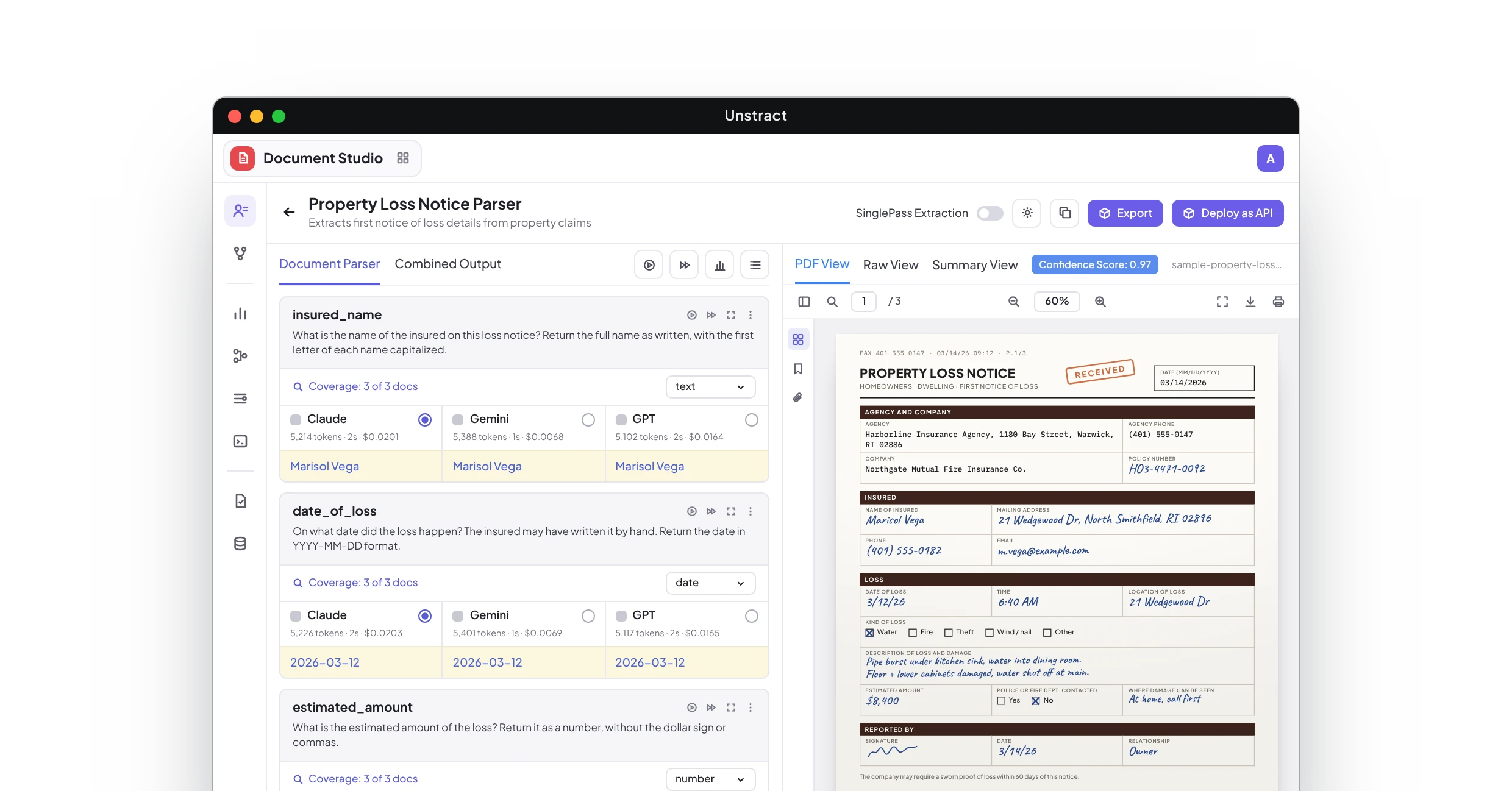
First notice of loss arrives as a handwritten claim form with phone photos of the damage clipped to it, and someone keys it into the claims system before an adjuster can look at it.
A 62-page submission by fax
The broker's ACORD 125, loss runs and schedule of values arrive as one fax, a page or two sideways, and clearance can't start until the named insured and FEIN have been typed in.
Loss runs in five layouts
Five years of losses from five prior carriers, each in its own layout, retyped into one spreadsheet before anyone can tie the totals or see the large losses.
A hundred carrier statements, no two alike
Monthly commission statements as PDFs, spreadsheets and portal downloads, matched line by line to the policies in the book by hand, with chargebacks found weeks later.
A certificate that doesn't meet the contract
A vendor's ACORD 25 shows a $1,000,000 limit where the contract requires $2,000,000, and nobody notices until there is a claim to ask about.
An endorsement the policy left out
The binder lists CG 20 37. The issued policy does not. Catching it means an account manager reading every page of every policy against the binder.
Insurance process automation has to start with what arrives, and most of it looks like this. Every page is read, keyed in and checked against the policy, the contract or the binder before an adjuster, an underwriter or an account manager can act on it. Unstract takes that on, so the file is read, checked and in your system before anyone opens it.
Intelligent automation in insurance, on one platform: parse any insurance document, extract the fields you need, and run the whole process, connected to the claims, policy and agency management systems you already use.
Parse any insurance document
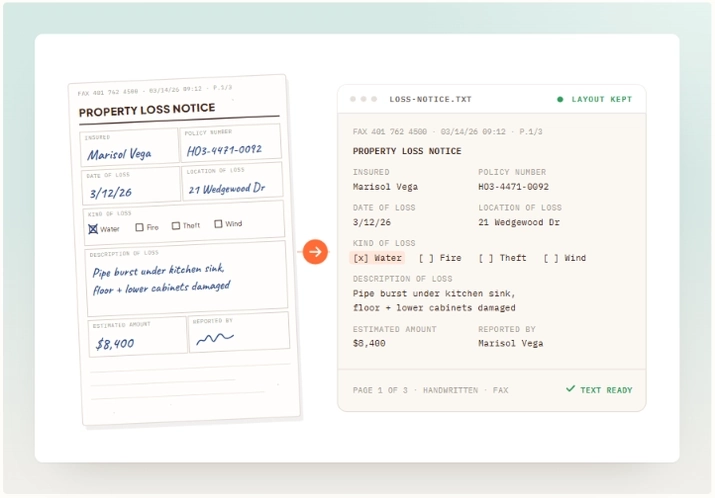
LLMWhisperer captures the full text of whatever reaches your desk, a handwritten claim form, a faxed ACORD submission, a loss run in the carrier’s own layout, with the layout preserved. A limit stays beside its coverage, a checked box keeps its label, and the incurred column is never read as paid.
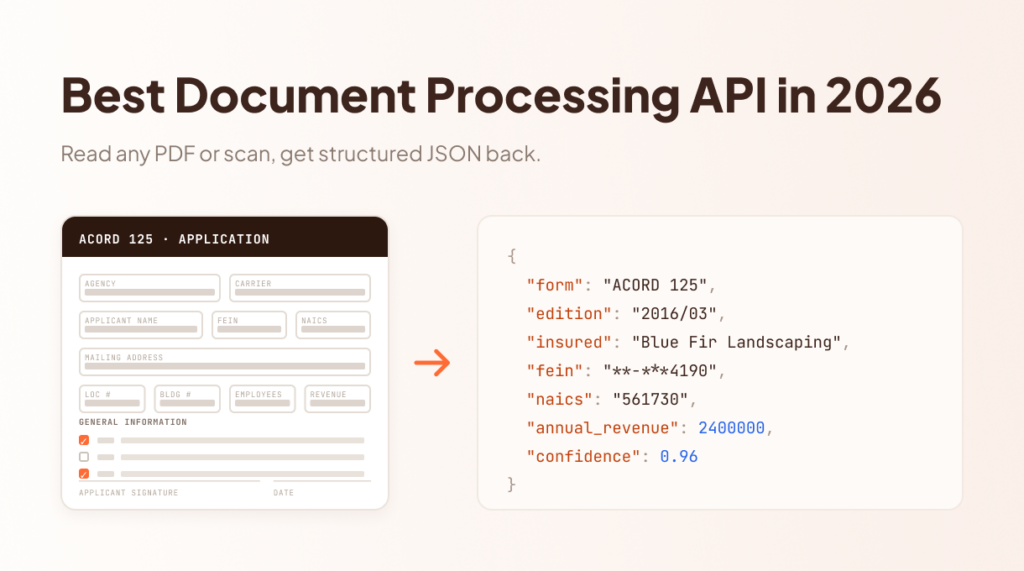
Document Studio turns every document into clean, structured JSON from a prompt that describes the fields you want, whichever carrier, ACORD edition or claim form it came on. A new carrier’s commission statement doesn’t need a new template, and a value that fails a check arrives flagged.
Flow picks up claim files, submissions, certificates and statements from the inbox, the portal or the agent upload, checks them against your policies, appetite, contracts and book, and posts the data to your claims or agency management system. Only the files that meet your human-in-the-loop conditions stop for a person, with the reason attached.
from receipt to a checked record in your claims, policy or agency management system
%
1
of files posted without a person touching them; adjusters and underwriters review 1 in 11
%
1
fewer hours on keying and checking in the first quarter
x
2
faster turnaround from broker submission to quote
Unstract makes it very easy to extract structured data from complex insurance and property documents. The integrated parsing + LLM step is quick and saves time compared to stitching together multiple tools.
Instead of manually sifting through complex PDFs and lengthy policy files, we can now quickly pull out the specific information we need - whether that's policy terms, coverage details, or claim data - and feed it directly into our workflows.
[T]he ability to hook into the studio using API calls… has sped up extraction processes for us massively
Claim files carry medical records, Social Security numbers and bank details; submissions carry loss histories and financials. Unstract is SOC 2, ISO 27001, GDPR and HIPAA compliant: documents are encrypted in transit and at rest, never used to train models, and retained only as long as you choose.
Reading the documents an insurance operation runs on, claim files, ACORD applications, loss runs, certificates, issued policies and commission statements, into checked, structured data without templates, and running the process around them: the checks against your policy records, contracts or book, the exceptions that stop for a person, and the post to your claims, policy or agency management system. Unstract covers the sixteen document types and six processes on this page.
02What is OCR in insurance, and does it read handwritten claim forms?
OCR turns a scan, a fax or a phone photo into text, which in insurance is most of what arrives. LLMWhisperer reads handwriting, faxes and rotated pages with the form’s layout kept, so each value is read from the box it belongs to, and every field carries a confidence score. A value below the threshold you set stops for an adjuster with the page beside it rather than going into the claims system as a guess.
03What automation tools do insurance companies use?
Insurance automation software usually means the systems of record, a claims system, a policy administration system or an agency management system, with RPA bots keying into them. None of them reads the paperwork: the claim file, the broker’s submission, the carrier’s statement. Unstract sits in front of them, turns those documents into checked data and posts it through the connectors above. That reading step is the part those tools leave to people.
04Does it check documents against each other and against our records?
Yes, and the checks follow the process. A claim is checked against the policy in force on the loss date, with the estimate against the invoice. A submission is checked against open submissions and your appetite. A certificate is checked against the vendor’s contract, a statement line against the policy in your book and the carrier’s schedule, an issued policy against the binder. A file that passes keeps moving; one that doesn’t stops with both values side by side.
05What happens when a file doesn't match?
It stops in a review queue, where the right person, an adjuster, an underwriter, a commissions specialist or an account manager, sees the field, the page it was read from and the record it disagrees with, side by side. They confirm, correct or send it back, the decision is recorded against the claim, submission or statement, and everything else keeps moving.
06Where does the data go?
Wherever your teams already work: a claims system such as Guidewire ClaimCenter or Duck Creek Claims, a policy administration system or underwriting workbench, an agency management system such as Applied Epic or Vertafore AMS360, accounting and payroll for commissions, a procurement system or ERP for certificates, a spreadsheet, a database or a data warehouse. Flow posts it as part of the run through the connectors above, so there is nothing to download and re-key.
07Is it safe to upload claim files and submissions?
Unstract is SOC 2, ISO 27001, GDPR and HIPAA compliant: documents are encrypted in transit and at rest, never used to train models, and retained only as long as you choose. Self-hosted options are available for carriers and agencies that need processing inside their own environment; details are in the Trust Center .
08Do we need developers, and how fast can we be live?
Not for Flow: in a process call we build the process around your own files, your checks and your claims, policy or agency management system, and most teams run their first live files within days. To try extraction today, start for free and upload an ACORD form, a claim or a commission statement.
Next step
Bring a week of claim files to the process call
The handwritten claim, the faxed submission, the carrier statement with forty columns. We run them live and show every field, check and exception.