Unstract reads IDs, bank statements, pay stubs, loan applications and business financials as they arrive, checks them against the application, your credit policy and each other, and delivers checked data to the systems your banking and lending teams already work in.
A 1003 completed in pen at the branch, a personal financial statement with figures squeezed into the margins, a beneficial ownership form with percentages written in. Someone types each one in by hand.
A whole loan file in one PDF
Pay stubs, W-2s, two years of tax returns, bank statements and the purchase contract arrive as a single 300-page upload, some pages photographed on a phone, some sideways, none in stacking order.
Statements in every bank's own layout
A borrower with three accounts sends three statement layouts, one listing deposits and withdrawals separately, one running a single ledger with a balance column, one with the summary on page four.
Hundreds of packages, no two alike
Every business borrower's CPA lays out the balance sheet and income statement differently, with their own line names, subtotals and fiscal years, and analysts spread hundreds of them a month by hand.
Income the pay stubs don't support
The 1003 says $9,400 a month. The pay stubs work out to $8,150, and the year-to-date total doesn't fit the pay period. Today someone catches it by hand, or underwriting does.
A missing month or an unlisted owner
Statements for January and March but not February. An ownership chart that adds up to 75%, with the last 25% owner named only on page 9 of the operating agreement.
Automation in finance has to start with what arrives, and most of it looks like this. Every page is read, keyed in and checked against the application, your credit policy and the other documents before a KYC analyst, loan processor or credit analyst can act on it. Unstract takes that on, so the file is read, checked and in your system before anyone opens it.
Banking automation works one process at a time, from the document that opens the file to the system that records the outcome.
Onboarding & verification
Lending & credit
Customer onboarding KYC
IDs, proof of address and formation documents are read and matched against the application, then handed to screening; mismatches stop for a KYC analyst.
Business financials are spread into your template and checked against your credit policy, then sent to your decision engine; exceptions stop for a credit analyst.
Finance process automation, on one platform: parse any banking or lending document, extract the fields you need, and run the whole process, connected to the core banking, loan and screening systems you already use.
Parse any banking document
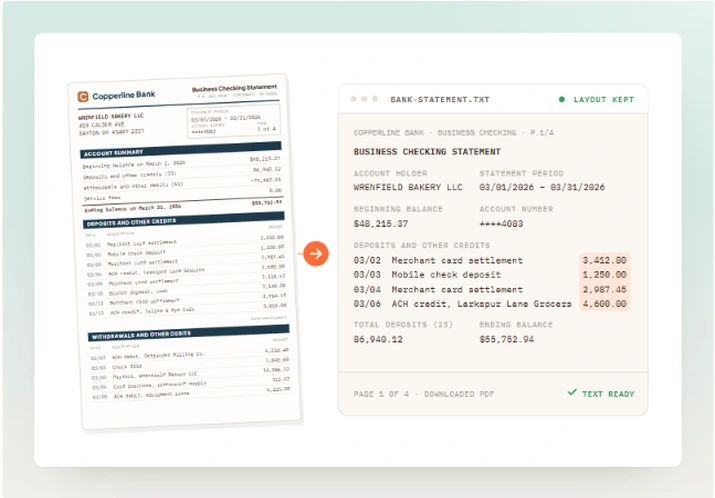
LLMWhisperer captures the full text of whatever reaches your desk, a 1003 filled in by hand, a phone photo of a pay stub, a 300-page loan upload, with the layout preserved. Each amount stays in its debit or credit column, a running balance stays on its line, and a checked box keeps its label.
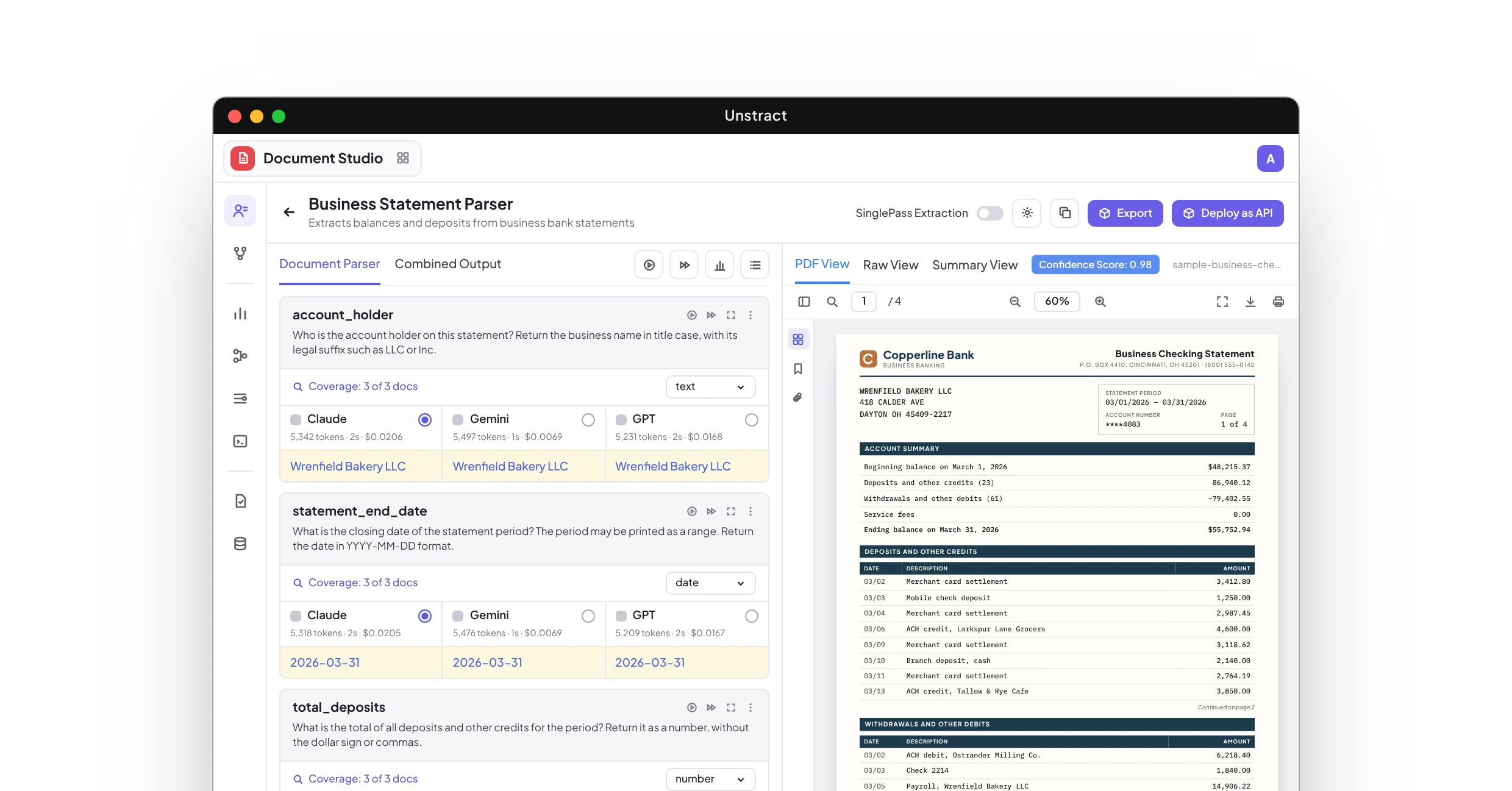
Document Studio turns every document into clean, structured JSON from a prompt that describes the fields you want, whichever bank, employer or accountant produced it. A statement from a bank you’ve never seen doesn’t need a new template, and a value that fails a check arrives flagged.
Flow picks up applications, loan files and credit packages from your portal, inbox and branch uploads, checks them against the application, your credit policy and each other, and posts the data to your screening, loan origination and decision systems. Only the files that meet your human-in-the-loop conditions stop for a person, with the reason attached.
from upload to a checked file in your onboarding system or LOS
%
1
of files posted without a person touching them; analysts and processors review 1 in 9
%
1
fewer hours on keying and checking in the first quarter
x
2
faster turnaround from application to credit decision
Unstract converts our unstructured KYB and onboarding packs, scanned PDFs, forms, and email attachments into clean, structured data in minutes. That automation cuts our onboarding timeline from hours to minutes while slashing data-entry errors to near zero.
Instead of manually sifting through complex PDFs and lengthy policy files, we can now quickly pull out the specific information we need - whether that's policy terms, coverage details, or claim data - and feed it directly into our workflows.
This is a wonderful utility that helps me recognize bank statements from Bank of America, I have been using it every day
Loan files carry Social Security numbers, income and account numbers; identity documents carry passport numbers, dates of birth and home addresses. Unstract is SOC 2, ISO 27001, GDPR and HIPAA compliant: documents are encrypted in transit and at rest, never used to train models, and retained only as long as you choose.
What banking & lending teams ask before they start
01What is finance automation?
It means reading the applications, IDs, statements, pay stubs and business financials behind every account and loan into checked, structured data without templates, and running the process around them: the checks against the application, your credit policy and the other documents, the exceptions that stop for a person, and the post to your core banking, loan or decision system. Unstract covers the seventeen document types and four processes on this page.
02 What is OCR in finance, and does it read handwritten forms?
OCR turns a scanned or photographed page into text, which covers most of what lenders receive, phone photos of pay stubs, faxed forms and scanned 1003s. LLMWhisperer reads handwriting, faxes and rotated pages with the layout kept, so each amount is read from the column it belongs to, and every field carries a confidence score. A value below the threshold you set stops for an analyst with the page beside it rather than going into the LOS as a guess.
03What finance automation software do banks and lenders use?
Most run on systems of record, core banking, a loan origination system, a CRM and screening tools, with RPA bots keying data between them. None of them reads the paperwork, the pay stubs, the business financials, the KYC pack. Unstract sits in front of them, turns those documents into checked data and posts it through the connectors above. That reading step is the part those tools leave to people.
04Does it check documents against each other and against our records?
Yes, and the checks follow the process. An application is checked against its ID, proof of address and certificate of good standing, with owners adding up to 100%. Pay stubs are checked against the W-2 and the bank deposits, and qualifying income against the 1003. Business financials are checked against the tax return and your credit policy. A file that passes keeps moving; one that doesn’t stops with both values side by side.
05What happens when a file doesn't match?
It stops in a review queue, where the right person, a KYC analyst, a loan processor, an underwriter or a credit analyst, sees the field, the page it was read from and the record it disagrees with, side by side. They confirm, correct or send it back, the decision is recorded against the application or loan file, and everything else keeps moving.
06Where does the data go?
Wherever your teams already work: screening such as LSEG World-Check One or LexisNexis Bridger Insight XG, a CRM such as Salesforce or HubSpot, core banking such as Fiserv or FIS, a loan origination system such as ICE Encompass or Dark Matter Empower, a decision engine such as FICO Platform, or a loan system such as nCino. Flow posts it as part of the run through the connectors above, so there is nothing to download and re-key.
07Is it safe to upload bank statements and IDs?
Unstract is SOC 2, ISO 27001, GDPR and HIPAA compliant: documents are encrypted in transit and at rest, never used to train models, and retained only as long as you choose. Self-hosted options are available for banks and lenders that need processing inside their own environment; details are in the Trust Center .
08Do we need developers, and how fast can we be live?
Not for Flow: in a process call we build the process around your own files, your checks and your LOS or core banking system, and most teams run their first live files within days. To try extraction today, start for free and upload a bank statement, a pay stub or a 1003.
Next step
Bring a week of loan files to the process call
The 300-page upload, the handwritten 1003, the accountant’s own balance sheet. We run them live and show every field, check and exception.